

pdfLaTeX2 pages1.85s compile53.0 KB
Academic Research Paper LaTeX Template
Polished academic article with tcolorbox theorem environments, colored section rules, custom title block, and styled abstract — ready for journal submission.
\source{academic-paper}
\documentclass[11pt,a4paper]{article}
\usepackage[margin=1in,top=0.85in]{geometry}
\usepackage{amsmath,amssymb,amsthm}
\usepackage{xcolor}
\usepackage{tcolorbox}
\usepackage{titlesec}
\usepackage{fancyhdr}
\usepackage{microtype}
\usepackage{enumitem}
\usepackage{hyperref}
\usepackage{tikz}

\tcbuselibrary{theorems,skins,breakable}

% --- Color palette ---
\definecolor{accent}{HTML}{1D4ED8}
\definecolor{accentlight}{HTML}{DBEAFE}
\definecolor{thmcolor}{HTML}{1E40AF}
\definecolor{lemcolor}{HTML}{065F46}
\definecolor{darktext}{HTML}{111827}
\definecolor{subtext}{HTML}{6B7280}
\definecolor{rulecol}{HTML}{93C5FD}

\hypersetup{colorlinks=true,linkcolor=accent,citecolor=accent,urlcolor=accent}

% --- Section styling ---
\titleformat{\section}
  {\large\bfseries\color{darktext}}
  {\textcolor{accent}{\thesection.}}{0.5em}{}
  [\vspace{1pt}\textcolor{rulecol}{\rule{\linewidth}{0.5pt}}]
\titleformat{\subsection}
  {\normalsize\bfseries\color{darktext}}
  {\textcolor{accent}{\thesubsection}}{0.5em}{}
\titlespacing{\section}{0pt}{14pt}{5pt}
\titlespacing{\subsection}{0pt}{10pt}{3pt}

% --- Header / footer ---
\pagestyle{fancy}
\fancyhf{}
\fancyhead[L]{\small\textcolor{subtext}{\textit{<<title>>}}}
\fancyhead[R]{\small\textcolor{subtext}{<<author>>}}
\fancyfoot[C]{\small\textcolor{subtext}{\thepage}}
\renewcommand{\headrulewidth}{0.3pt}
\renewcommand{\headrule}{\hbox to\headwidth{\color{rulecol}\leaders\hrule height \headrulewidth\hfill}}

% --- Theorem boxes ---
\tcbset{
  thmstyle/.style={
    enhanced,breakable,
    colback=#1!6,colframe=#1!70!black,
    fonttitle=\bfseries\small,
    left=6pt,right=6pt,top=4pt,bottom=4pt,
    arc=3pt,boxrule=0.5pt,
  }
}
\newtcbtheorem[number within=section]{theorem}{Theorem}
  {thmstyle=thmcolor,attach boxed title to top left={yshift=-2mm,xshift=4mm},
   boxed title style={colback=thmcolor,arc=2pt,boxrule=0pt}}{thm}
\newtcbtheorem[use counter from=theorem]{lemma}{Lemma}
  {thmstyle=lemcolor,attach boxed title to top left={yshift=-2mm,xshift=4mm},
   boxed title style={colback=lemcolor,arc=2pt,boxrule=0pt}}{lem}
\newtcbtheorem[use counter from=theorem]{corollary}{Corollary}
  {thmstyle=thmcolor!70!lemcolor,attach boxed title to top left={yshift=-2mm,xshift=4mm},
   boxed title style={colback=thmcolor!70!lemcolor,arc=2pt,boxrule=0pt}}{cor}

\newenvironment{proof-env}{\noindent\textit{Proof.}\enspace}{\hfill$\square$\medskip}

% --- Title block ---
\makeatletter
\renewcommand{\maketitle}{%
  \begin{center}
    \begin{tikzpicture}
      \node[inner sep=0pt,text width=\textwidth-2pt,align=center] (t) {%
        {\LARGE\bfseries\color{darktext} \@title}\par\vspace{6pt}
        {\normalsize\color{subtext} \@author}\par\vspace{2pt}
        {\small\color{subtext} \@date}
      };
      \draw[rulecol,line width=1pt] (t.south west) -- (t.south east);
    \end{tikzpicture}
  \end{center}
  \vspace{6pt}
}
\makeatother

\title{<<title>>}
\author{<<author>>\\\small\textit{<<department>>}}
\date{\today}

\begin{document}
\maketitle

% --- Abstract ---
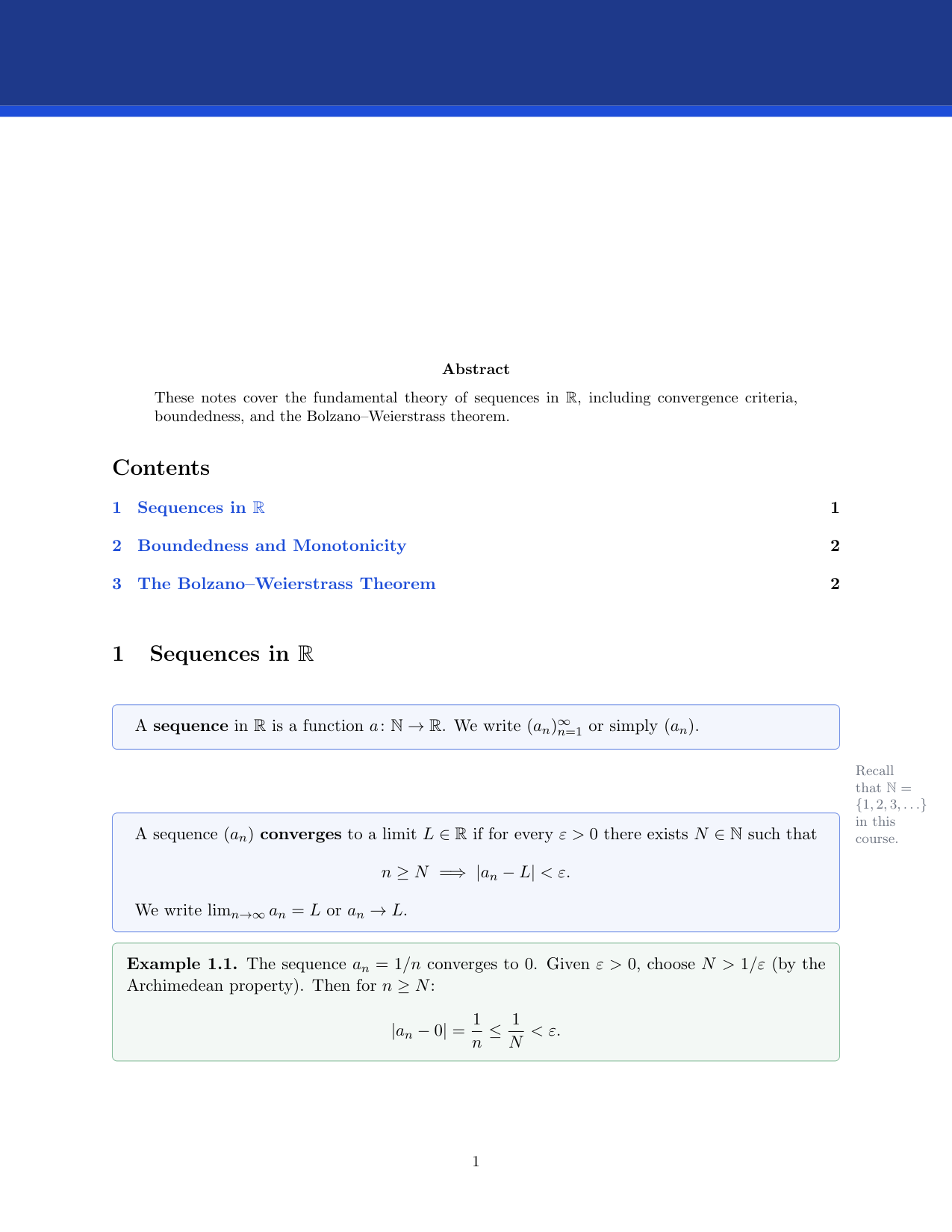
\begin{tcolorbox}[
  enhanced,colback=accentlight,colframe=accent,
  title=\textsf{Abstract},fonttitle=\bfseries\small,
  arc=3pt,boxrule=0.6pt,left=8pt,right=8pt,top=5pt,bottom=5pt,
  attach boxed title to top left={yshift=-2mm,xshift=5mm},
  boxed title style={colback=accent,arc=2pt,boxrule=0pt,
    fontupper=\color{white}\bfseries\small}
]
\small <<abstract_text>>
\end{tcolorbox}

\vspace{6pt}

\section{Introduction}

Let $f:\mathbb{R}^n\to\mathbb{R}$ be an $L$-smooth function, i.e., its gradient satisfies
$\|\nabla f(x) - \nabla f(y)\| \le L\|x-y\|$ for all $x,y\in\mathbb{R}^n$.
The \emph{gradient descent} iteration is defined by
\[
  x_{t+1} = x_t - \eta\,\nabla f(x_t),
  \qquad \eta \in \Bigl(0,\,\tfrac{1}{L}\Bigr],
\]
where $\eta$ is the step size. Understanding the convergence of this simple procedure in the non-convex setting is fundamental to modern machine learning theory.

\begin{theorem}{Main Convergence Result}{convergence}
  Let $f:\mathbb{R}^n\to\mathbb{R}$ be $L$-smooth and bounded below.
  Running gradient descent with step size $\eta = 1/\sqrt{T}$ for $T$ iterations yields
  \[
    \min_{0 \le t < T}\|\nabla f(x_t)\|^2
    \;\le\;
    \frac{2L\bigl(f(x_0)-f^*\bigr)}{\sqrt{T}}
    \;=\;
    \mathcal{O}\!\left(\frac{1}{\sqrt{T}}\right).
  \]
\end{theorem}

\begin{proof-env}
  Applying the $L$-smoothness descent lemma repeatedly and telescoping yields the bound.
\end{proof-env}

\begin{lemma}{Descent Lemma}{descent}
  For any $L$-smooth $f$ and step size $\eta \le 1/L$,
  \[
    f(x_{t+1}) \;\le\; f(x_t) - \frac{\eta}{2}\|\nabla f(x_t)\|^2.
  \]
\end{lemma}

\section{Methodology}

\subsection{Convergence Analysis}

Summing the descent lemma over $t = 0,\ldots,T-1$ and using the bounded-below assumption $f(x)\ge f^*$ gives a total decrease bound. Dividing by $T$ and minimizing over all iterates establishes the convergence rate.

\subsection{Practical Considerations}

\begin{itemize}[leftmargin=*,itemsep=3pt]
  \item \textbf{Step size selection:} Setting $\eta=1/L$ (if $L$ is known) yields the sharpest constant.
  \item \textbf{Stochastic variant:} Mini-batch SGD achieves the same $\mathcal{O}(1/\sqrt{T})$ rate in expectation under standard noise assumptions.
  \item \textbf{Adaptive methods:} Adam and AdaGrad adapt the step size per coordinate but lack matching worst-case guarantees in general.
\end{itemize}

\section{Related Work}

Classical convergence analysis of first-order methods dates to Nesterov (1983, 2004). The non-convex analysis presented here follows the framework of Ghadimi and Lan (2013). Stochastic extensions and variance-reduction techniques have been extensively studied; see the survey by Bottou et al.\ (2018) for an overview.

\section{Conclusion}

We have established an $\mathcal{O}(1/\sqrt{T})$ convergence rate for gradient descent on $L$-smooth non-convex functions — a fundamental guarantee underpinning the empirical success of gradient-based optimization in deep learning.

\end{document}
dashboard.templates.seeCompiledPdf
dashboard.templates.noApiKeyRequired
LaTeX packages used
\geometryPage margins and layout control
\amsmathAdvanced math environments and commands
\amssymbAMS symbol fonts and extra math symbols
\amsthmTheorem, lemma, and proof environments
\xcolorColor definitions and usage
\tcolorboxColored and framed text boxes
\titlesecSection and heading formatting
\fancyhdrCustom headers and footers
\microtypeMicro-typographic enhancements (kerning, tracking)
\enumitemCustomizable list environments
\hyperrefHyperlinks and PDF metadata
\tikzDrawing diagrams and vector graphics
Template variables
| Variable | Type | Default | Description |
|---|---|---|---|
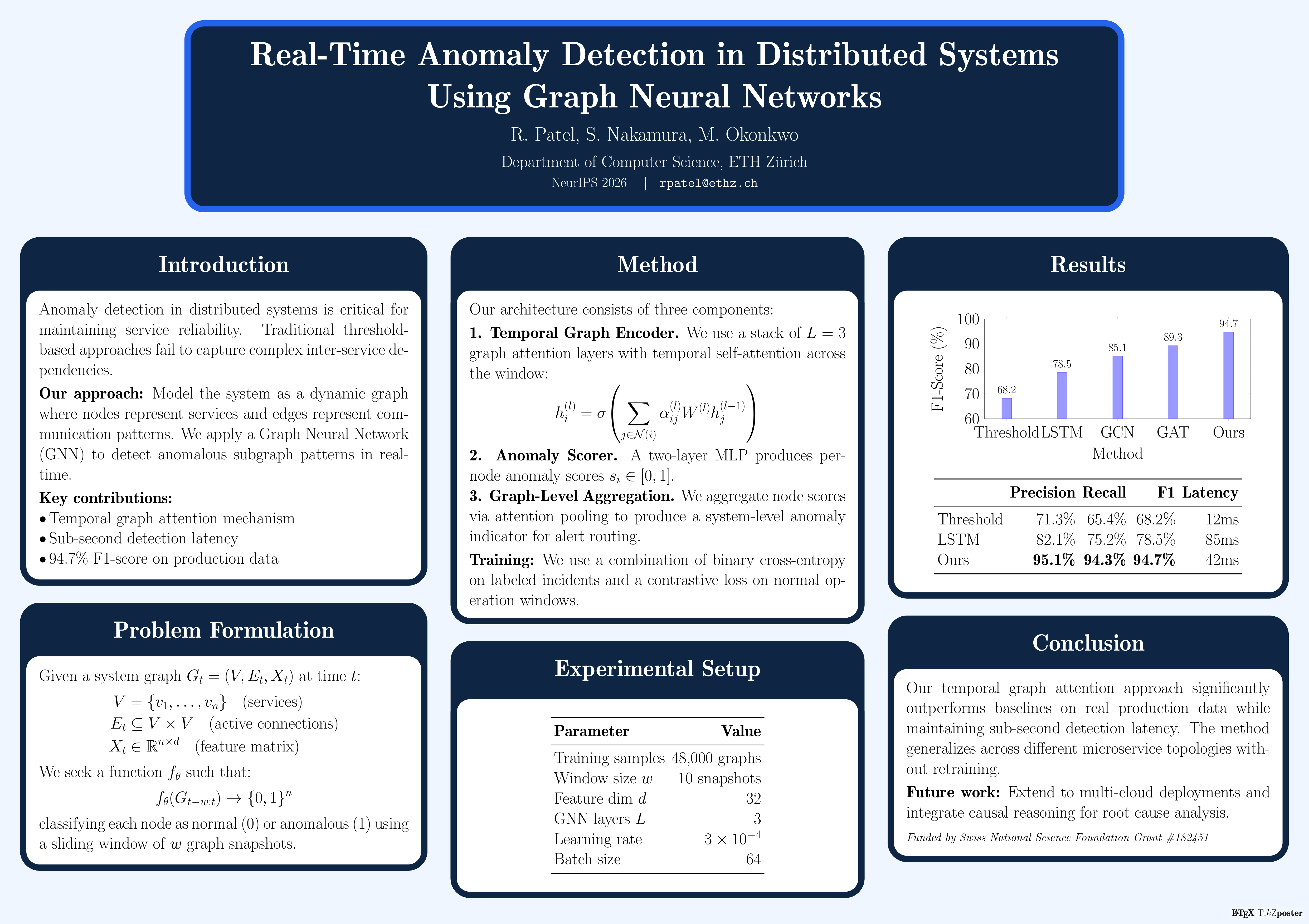
| title | string | On the Convergence of Gradient Descent in Non-Convex Optimization | Paper title |
| author | string | J.~Smith \and A.~Doe | Author names (use \and to separate) |
| department | string | Department of Mathematics | Department or affiliation |
| abstract_text | string | We study convergence properties of gradient descent in non-convex optimization landscapes under standard $L$-smoothness assumptions. Our main result establishes an $\mathcal{O}(1/\sqrt{T})$ rate. | Paper abstract |
More academic templates

Customize and compile instantly
Load this template into the playground, edit, and see your PDF in seconds.